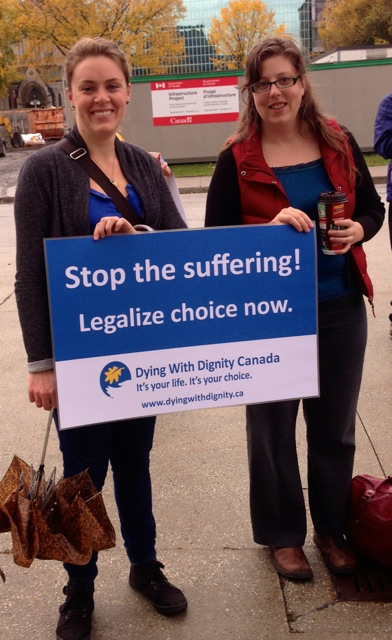
On October 15, 2014, the Ottawa Chapter of Dying With Dignity Canada hosted a rally on the steps of the Supreme Court of Canada, in support of Kay Carter’s family, Gloria Taylor, and Dr. William Shoichet as the Court was hearing the Carter case. Kay’s family was there, as were our supporters, to make sure that our Voice for Choice was heard.
It was a long time since Sue Rodriguez had launched her own challenge to the Criminal Code prohibition on assisting suicide, and asked the question ‘Whose body is this?’ Sadly, she was disappointed by an unfavourable split decision in 1993. But Dying With Dignity Canada (DWDC) carried on its important work of advocacy and education. By October 2015, the Supreme Court was hearing another appeal asking that people across Canada have the right to choose their own good death.
October 15, 2014 rally participants
I remember well the moment the Supreme Court’s decision in Carter was released in the great hall of the Court in Ottawa on February 6, 2015. I was waiting anxiously with Steven Fletcher, then a Conservative MP from Manitoba and supporter of medical aid in dying, and Kelly Doctor, one of the lawyers who had represented DWDC as an intervenor in the Carter case. There was a swell of sound in the hall and then the whispers began, and finally, someone shouted, “the Carter decision was upheld unanimously by the Supreme Court.”
Dr. James Downar speaking at the rally. Two Chapter volunteers in the background – Eva Kmiecic and Marie-Helene Zahles.
We spent a moment in disbelief, and then hugged each other, tears in our eyes. I thought of my own family member, who had died suffering terribly from terminal cancer, and whose memory drove me to embark on this journey with DWDC. Asked by the media to comment on behalf of DWDC, I told them how much it meant to me to know that, in future, individuals who might find themselves in a similar situation to my family member would now have a Charter right to make their own choices about end of life.
It was such a momentous occasion that I found myself heading up to the Supreme Court office to get my own copy of the decision which now, after 10 years, is dog-eared and heavily annotated. But every time that I refer to it, I remember that day, and I remember the first paragraph of the decision, which, to me, said it all – no Canadian should have to suffer unnecessarily as they approach end of life.
“I. [1] It is a crime in Canada to assist another person in end her own life. As a result, people who are grievously and irremediably ill cannot seek a physician’s assistance and may be condemned to a life of severe and intolerable suffering. A person facing this prospect has two options: she can take her own life prematurely, often by violent or dangerous means, or she can suffer until she dies from natural causes. The choice is cruel.”
Watch Wendy Bancroft’s interview with Lee Carter about her mother and her impact on end-of-life choice in Canada.
Dying With Dignity Canada’s work is far from over. There are still exclusions embedded by the original legislation passed by the Federal government. Individuals with mental disorders, such as John Scully, who has been suffering for decades and gone through endless rounds of unsuccessful treatments, are excluded. So are individuals who are even now being diagnosed with a capacity-impairing condition such as Alzheimer’s, and who want the opportunity to make an advance request for medical assistance in dying so that they do not in future have to languish in conditions they determine would cause them intolerable suffering. Fortunately, Québec has led the way once again with a regime permitting advance requests. We cannot simply hope the Federal government and provincial governments will make the necessary legislative changes. We must carry on, all DWDC supporters, to ensure continued and better access to quality end-of-life care, including medical aid in dying.
Watch a series of reactions to the Carter decision from the CBC archives here.